
The Boulevardier (1927)
A bourbon, sweet Italian vermouth, and Campari cocktail adapted from a 1927 Paris recipe, with an orange twist.
- Original yieldYield
- 1 cocktail1 cocktail
- PrepPrep time
- TotalTotal time
Published Updated
Original recipe: 1 cocktail
The story behind the recipe
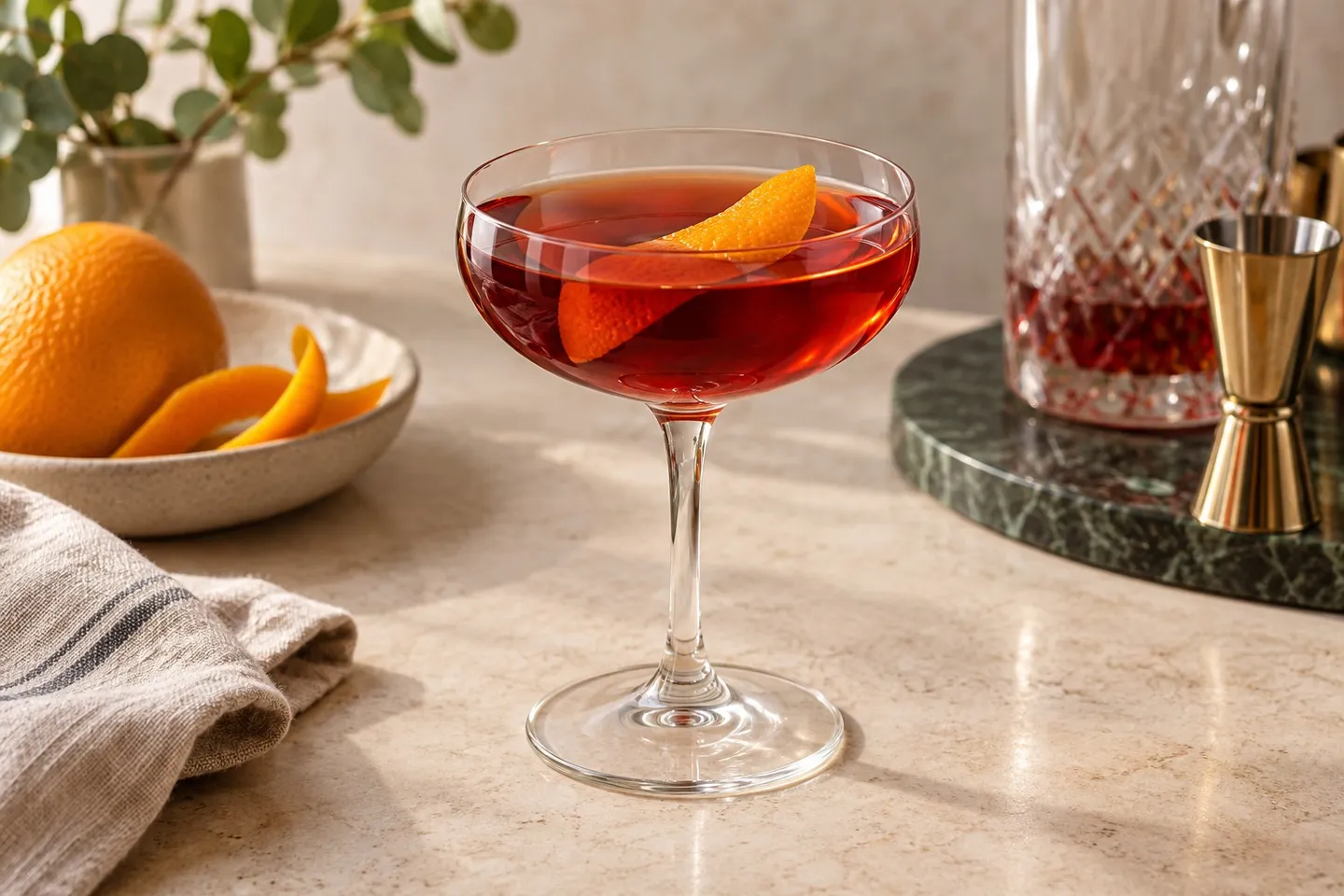
Bourbon, sweet vermouth and Campari make a deep red Boulevardier with a bitter edge. An orange twist brings scent above the stirred drink.
Bourbon where a Negroni has gin
Comparing the ingredients with a Negroni makes the whiskey choice easy to picture. Bourbon stands beside sweet vermouth and Campari in place of gin, bringing its oak-aged flavor into the familiar bittersweet arrangement.
That describes the two drinks in front of you; it doesn't tell you how the original Boulevardier was invented. The 1927 evidence is a short passage in a book, not a bartender's narrated experiment.
Our serving gives bourbon a larger share than either companion. It's still clearly bitter and wine-rich, with no juice or syrup to make it a citrus sour.
Read more about this recipe
Tucked into an essay
Arthur Moss includes the Boulevardier in his essay in Harry McElhone's Barflies and Cocktails. The 1927 passage credits Erskine Gwynne and gives equal thirds of Campari, Italian vermouth and bourbon.
Finding the formula inside prose is part of the book's charm. A named person and three ingredients can appear amid the voices around the bar, without a separate numbered recipe and detailed serving instructions.
The Jazz Age article puts that passage beside the newspaper account of Scofflaw and McElhone's other formulas. The recipes carry traces of people as well as lists of bottles.
Sweet wine beside the bitter bottle
Sweet Italian vermouth supplies both wine flavor and sweetness. There's no need for a separate sugar syrup in this mixture. Dry vermouth would lead to another drink, so choose the style listed.
Campari supplies the bitter ingredient. A full measure of it is much more noticeable than a few drops of bitters in a whiskey cocktail. The orange twist adds a bright scent, but it doesn't remove that bitterness.
Refrigerate vermouth after opening and use it while the flavor is fresh. An old bottle left warm for ages can undo the care taken over the bourbon and measuring.
Higher-proof bourbon is an option in the notes if you'd like a stronger whiskey presence. That choice is about the flavor you prefer alongside the wine and Campari, not a requirement to buy the strongest bottle available.
One mixture, two glasses
A coupe holds the strained drink without serving ice. A rocks glass can receive it over a fresh large cube, which continues to dilute and cool it while you sip. Both start with the same stirred mixture.
The source passage supplies no glass or garnish. These are modern serving choices, useful because they let a host offer the drink in a way that suits the occasion.
Chilling the glass takes most of the stated elapsed time; the active stir is brief. Prepare the vessel before mixing so the orange oils can be expressed over a cold drink ready to serve.
The orange peel is enough decoration for that deep red liquid. Offer the Boulevardier by its ingredients and bitter style, and let someone decide whether that's the glass they'd like.
For more of the bar-book background, read about cocktails in 1920s London and Paris on our sister site, Forgotten Drink.
Make it your wayOriginal: 1 serving · Makes 1 cocktail
Original recipe: 1 cocktail
Ingredients
For 1 cocktail. Quantities are shown as written.
Source measurement convention: Metric. Explicit unit definitions take precedence; unconfirmed measures must be checked before conversion.
Original quantities for 1 cocktail.
- Kentucky bourbon whiskey45 ml
- Sweet Italian vermouth30 ml
- Campari30 ml
- Wide orange peel twist (for garnish)1
Measurement notes
Measurement notes
Original ingredients
- 45 ml Kentucky bourbon whiskey
- 30 ml sweet Italian vermouth
- 30 ml Campari
- 1 wide orange peel twist (for garnish)
Equipment
 Mixing glass
 Bar spoon
 Julep strainer
 Coupe glass or rocks glass
Instructions
Chill the serving glass
Chill a coupe glass or rocks glass in the freezer for 10 minutes.
Combine bourbon, vermouth and Campari
In a mixing glass, combine the Kentucky bourbon whiskey, sweet Italian vermouth, and Campari.
Fill the mixing glass with ice
Fill the mixing glass with cracked ice.
Stir to chill and dilute
Stir briskly with a bar spoon for 25 to 30 seconds until thoroughly chilled and properly diluted.
Strain into the chilled glass
Strain the liquid through a julep strainer into the chilled glass (or over a fresh large ice cube if serving in a rocks glass).
Express and add orange peel
Express the oils from the wide orange peel twist over the drink by bending the peel with its colored outer surface toward the drink. Rub it around the rim and drop it into the glass.
Estimated calories 220 kcal
Nutrition portion: whole recipe · Original yield: 1 cocktail
Source & assumptions
Ingredient-based estimate using CoFID 2021, identified manufacturer information. Approximately 220 kcal per nutrition portion. Uses 40% ABV bourbon, 19% ABV Gualco sweet Italian vermouth and 25% ABV Campari. Orange peel is excluded. Ingredients, brands and preparation affect values.
Recipe notes
When adjusting quantities
Scale ingredients proportionally. Stir over ice to achieve optimal dilution and temperature.
Original recipe notes
These notes describe the original recipe. Quantities mentioned here do not change when you adjust servings.
Arthur Moss's essay in Harry McElhone, Barflies and Cocktails (1927), p. 80, gives equal thirds. Our 45:30:30 ml proportions favor bourbon; we also add stirring instructions, glass choices and an orange garnish.
A bourbon around 90 to 100 proof is an option for a stronger spirit presence. Choose one you enjoy with the vermouth and Campari.
Refrigerate sweet vermouth after opening and use it while its flavor is fresh.
Read the scaling guide. Times, temperatures and equipment need their own consideration. Open the recipe tool to review and correct individual amounts.
Sources and attribution
Harry McElhone, Barflies and Cocktails (Paris: LECRAM PRESS, 1927), p. 80
Recipe details
- Recipe tradition
- Vintage
- Course or meal
- Drink
- Cuisine
- French
- Source decade
- 1920s
- Browse category
- Drinks & Cocktails