
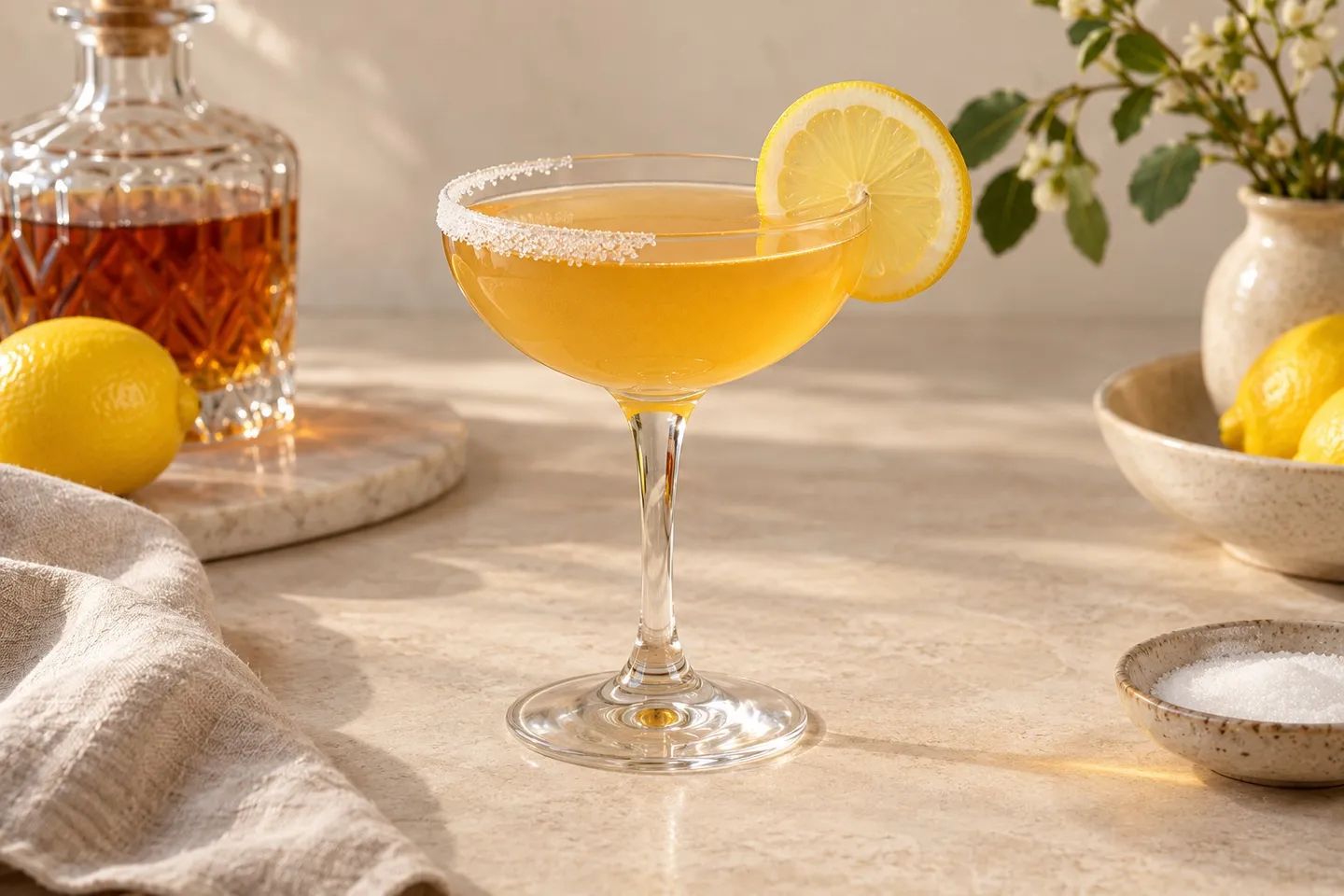
The Sidecar (1923)
A Cognac, Cointreau, and fresh lemon sour adapted from McElhone's 1923 Sidecar, with an optional half-sugar rim.
- Original yieldYield
- 1 cocktail1 cocktail
- PrepPrep time
- TotalTotal time
Published Updated
Original recipe: 1 cocktail
The story behind the recipe
A half-sugar rim lets someone turn a Sidecar toward the sip they want. One edge brings a little extra sweetness; the other leaves Cognac, Cointreau and lemon to speak directly. The mixed cocktail stays the same whichever side of the glass meets your lips.
Brandy, orange liqueur and lemon
Cognac supplies the brandy flavor. Cointreau adds orange and sweetness, while fresh lemon gives the drink its tart edge. There is no separate syrup in the mixture.
That makes the liqueur choice important. Dry triple sec is an offered alternative, but different bottles can change sweetness and orange flavor. Start with the named Cointreau if you want the formula as written.
The same applies to the brandy. Cognac or the suitable aged grape-brandy alternative should be something you enjoy tasting. A short sour gives it more space than a long fruit mixer would.
Read more about this recipe
Equal thirds in the old book
Harry McElhone's 1923 Side-Car entry gives equal thirds of Cointreau, brandy and lemon; Cognac is our choice of brandy. It credits MacGarry, the bartender at Buck's Club in London. The central formula appears again in Barflies and Cocktails in 1927.
The recipe offers a person and place beside a few measured ingredients.
The Jazz Age article uses Sidecar alongside several other formulas whose names carry expectations. In this case, the familiar three-ingredient drink is there, but its equal proportions differ from many later spirit-forward servings.
Our recipe gives brandy more room, with a little less lemon than Cointreau. It's a modern adjustment you can taste as a stronger brandy presence, not simply the same thirds written in milliliters.
Sugar at the edge
The optional rim remains outside the liquid. It can change a sip without increasing the sugar dissolved through every part of the cocktail.
That is the reason to coat only half. Someone who enjoys a little crust can turn toward it; someone who wants the plain tart mixture has another edge available. A full rim would offer less of that choice.
Prepare the glass before shaking if you want the sugar. The cocktail can then go straight into a cold, ready vessel, without waiting while a bowl of sugar is found.
Lemon in the glass and above it
The juice is measured after straining out heavy pulp. It joins the brandy and liqueur during the shake, with mixing ice providing cold and dilution.
The garnish is separate. A wheel can rest at the rim, or a twist can send peel oils over the surface before joining the glass. Both are modern serving options in this recipe.
For a more elaborate brandy presentation, the Brandy Crusta lines its bowl with a broad lemon coil inside a sugar crust. Sidecar asks much less of the peel.
For more of the bar-book background, read about cocktails in 1920s London and Paris on our sister site, Forgotten Drink.
Make it your wayOriginal: 1 serving · Makes 1 cocktail
Original recipe: 1 cocktail
Ingredients
For 1 cocktail. Quantities are shown as written.
Source measurement convention: Metric. Explicit unit definitions take precedence; unconfirmed measures must be checked before conversion.
Original quantities for 1 cocktail.
- French Cognac (or VSOP brandy)45 ml
- Cointreau (or dry triple sec)25 ml
- Fresh lemon juice (strained)20 ml
- Superfine sugar (for optional half-rim)5 g
- Lemon wheel (or twist, for garnish)1
- Lemon wedge (for optional rimming)1
Measurement notes
Measurement notes
Original ingredients
- 45 ml French Cognac (or VSOP brandy)
- 25 ml Cointreau (or dry triple sec)
- 20 ml fresh lemon juice (strained)
- 5 g superfine sugar (for optional half-rim)
- 1 lemon wheel (or twist, for garnish)
- 1 lemon wedge (for optional rimming)
Equipment
 Cocktail shaker
 Hawthorne strainer
 Fine mesh strainer
 Chilled coupe glass
Instructions
Prepare the optional half-sugar rim
If desired, rub a lemon wedge along half the rim of a chilled coupe glass and dip into the superfine sugar to create a delicate half-sugar rim.
Combine Cognac, Cointreau and lemon
In a cocktail shaker, combine the French Cognac, Cointreau, and fresh lemon juice.
Fill the shaker with ice
Fill the shaker with cracked ice.
Shake to chill
Seal and shake vigorously for 12 to 15 seconds until thoroughly chilled.
Double-strain into the prepared coupe
Double strain through a Hawthorne strainer and fine mesh sieve into the prepared coupe glass.
Garnish with lemon and serve
Garnish with the lemon wheel perched on the rim, or express the oils from the lemon twist over the drink and drop it into the glass. Serve immediately.
Estimated calories 180 kcal
Nutrition portion: whole recipe · Original yield: 1 cocktail
Source & assumptions
Ingredient-based estimate using CoFID 2021, USDA household-measure references, representative labels for Cointreau L’Unique (40% ABV). About 180 kcal per nutrition portion (whole recipe). Uses a representative 40% ABV brandy and the named 40% ABV Cointreau option. Excludes the optional sugar rim and lemon garnish; a full 5 g sugar rim adds about 20 kcal. Actual ingredients and preparation affect the estimate.
Recipe notes
When adjusting quantities
Scale ingredients proportionally. Shake vigorously with ice to aerate and chill.
Original recipe notes
These notes describe the original recipe. Quantities mentioned here do not change when you adjust servings.
McElhone, Harry of Ciro's ABC of Mixing Cocktails (1923), p. 65; Barflies and Cocktails (1927), p. 64. The equal-third source becomes a spirit-forward modern measure, with detailed shaking and straining, optional half-sugar rim and lemon garnish.
The half-rim lets the drinker choose a sweeter or unsugared edge. Its sugar is for preparing the glass, not adding to the liquid.
Choose Cognac or another suitable aged grape brandy whose flavor you enjoy. Dry triple sec is a variation on Cointreau and can change sweetness and orange character.
Read the scaling guide. Times, temperatures and equipment need their own consideration. Open the recipe tool to review and correct individual amounts.
Sources and attribution
Harry McElhone, Harry of Ciro's ABC of Mixing Cocktails (1923), p. 65; Barflies and Cocktails (1927), p. 64
Recipe details
- Recipe tradition
- Vintage
- Course or meal
- Drink
- Cuisine
- Other / International
- Source decade
- 1920s
- Browse category
- Drinks & Cocktails