
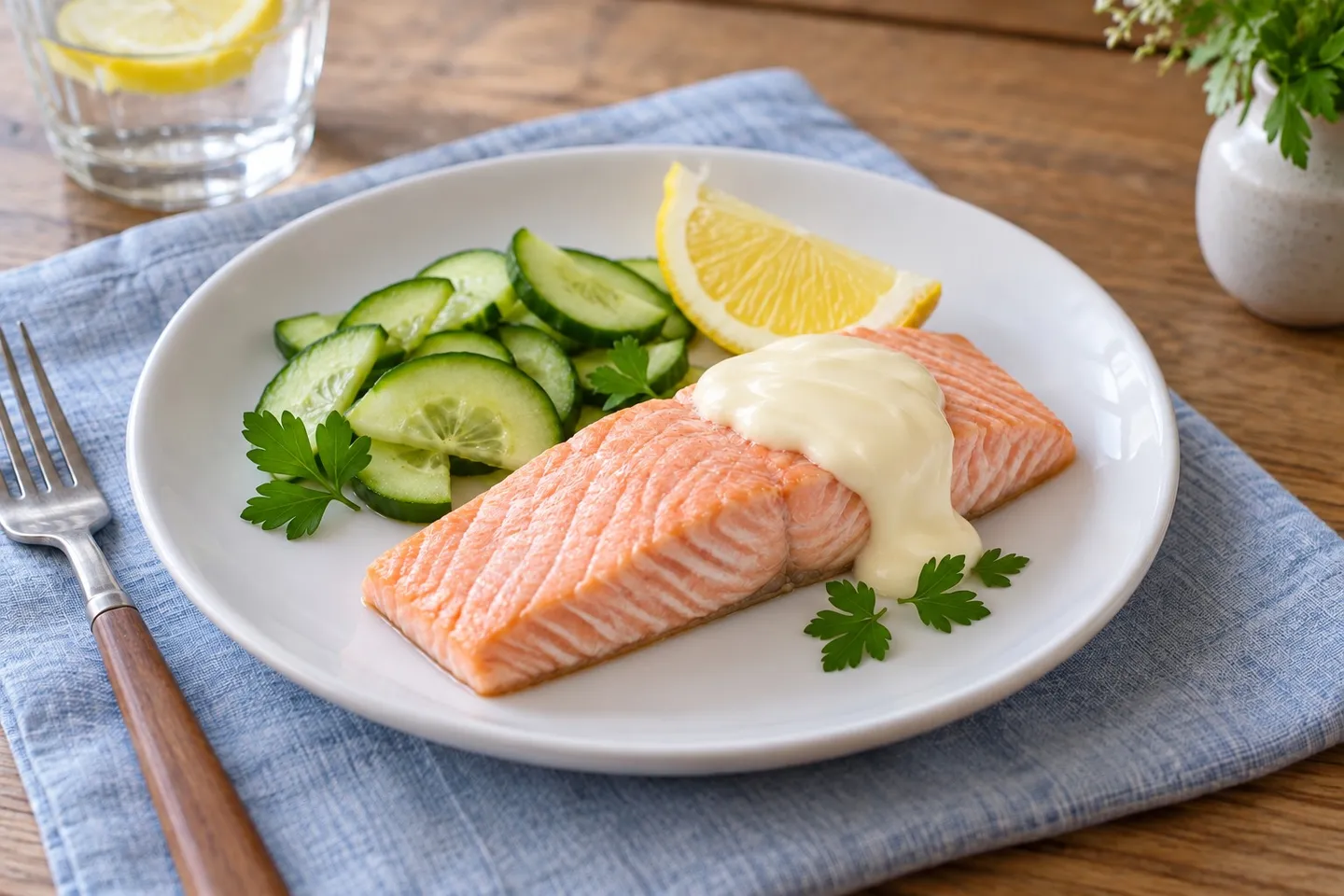
Salmon Mayonnaise (Titanic First-Class Menu, 1912)
Gently poached salmon served cold with lemon mayonnaise, cucumber, and parsley, inspired by Titanic's April 14 first-class luncheon menu.
- Original yieldYield
- 4 luncheon servings4 luncheon servings
- PrepPrep time
- CookCook time
- TotalTotal time
Includes 10 minutes to release steam and a planned 90-minute refrigerator chill. Chill longer if needed until cold; prepare the cucumber and sauce during that time.
Published Updated
Original recipe: 4 luncheon servings
The story behind the recipe
Salmon mayonnaise was a first-class luncheon choice on Titanic on April 14, 1912. Our home version is a cold lunch plate of poached salmon, lemon mayonnaise and crisp cucumber slices.
Luncheon, not mousseline
The first-class luncheon card documented in Christie's catalogue lists salmon mayonnaise among buffet choices. It is a different dish from the salmon with mousseline sauce at dinner. Our recipe follows the cold-lunch idea, with individual poached portions, lemon mayonnaise, cucumber, parsley, and lemon.
Read more about this recipe
A card can name a dish
The surviving menu places this food in a particular meal and passenger class. It doesn't give portion sizes, mayonnaise ingredients, or the ship's preparation. Nor does a listed choice prove that every first-class passenger ate it. The separately charged restaurant aboard is another setting again.
For a home version, two cookbooks from before the voyage offer useful details. Fannie Merritt Farmer's 1896 Boston Cooking-School Cook Book describes boiled salmon and, in its related fish directions, water seasoned with salt and lemon juice or vinegar. Lemon and parsley accompany the salmon on a hot platter, with sauces other than mayonnaise.
Auguste Escoffier's 1903 Le Guide Culinaire supplies the cold-service connection. His cold-salmon note mentions cold sauces and vegetable salads, including cucumber salad for English-style service. The books contribute different parts of the plate; neither is claimed to have supplied Titanic's cooks.
We've brought the period fish preparation and cold-service setting into one measured home recipe. Four fillet portions, purchased pasteurized-egg mayonnaise, lemon seasoning, cucumber presentation, and the cooking and cooling guidance are modern choices.
The cold plate takes time
A short poach is only the hot part of this lunch. The fish needs to cool and chill before it reaches the plate, and the sauce stays refrigerated too. Plan for that elapsed time rather than counting only the minutes at the stove.
Keep the cucumber separate until plating. Its moisture belongs with the vegetable, not in a dressing waiting to be spooned onto the fish. Thin slices also give a different texture alongside the soft salmon without needing a second cooked side.
Purchased mayonnaise keeps the sauce straightforward. Lemon juice supplies sharpness; parsley and a lemon wedge finish the plate. There's no need to surround a small fillet with an elaborate arrangement that makes cold fish difficult to serve.
Three meals, three menu settings
Our Titanic article places this luncheon choice beside second-class chicken curry and third-class plum pudding. They belong to different meals and menu records, not one reconstructed sitting.
The salmon can simply be lunch. Poach portions of similar thickness, keep them cold until serving, and let each plate have enough room for fish, a spoonful of sauce, and cucumber. A cold dish needs as much care at the table as it did in the pan.
Make it your wayOriginal: 4 servings · Makes 4 luncheon servings
Original recipe: 4 luncheon servings
Ingredients
For 4 luncheon servings. Quantities are shown as written.
Source measurement convention: Metric. Explicit unit definitions take precedence; unconfirmed measures must be checked before conversion.
Original quantities for 4 luncheon servings.
- Skinless boneless salmon fillets, cut into portions about 2 to 3 cm thick600 g
- Water, for poaching1 l
- Fresh lemon juice, for poaching30 ml
- Fine salt, for poaching1/2 metric tsp
- Commercially prepared mayonnaise made with pasteurized eggs120 g
- Fresh lemon juice, for the sauce15 ml
- Cucumber, thinly sliced into half-moons150 g
- Flat-leaf parsley leaves, for serving5 g
- Lemon wedges, for serving4
Measurement notes
- fine salt, for poaching: tsp: 1 = 5 ml.
Measurement notes
Original ingredients
- 600 g skinless boneless salmon fillets, cut into portions about 2 to 3 cm thick
- 1 liter water, for poaching
- 30 ml fresh lemon juice, for poaching
- 1/2 tsp fine salt, for poachingtsp: 1 = 5 ml.
- 120 g commercially prepared mayonnaise made with pasteurized eggs
- 15 ml fresh lemon juice, for the sauce
- 150 g cucumber, thinly sliced into half-moons
- 5 g flat-leaf parsley leaves, for serving
- 4 lemon wedges, for serving
Equipment
 10-inch or 12-inch heavy saute pan or saucier
 Food thermometer
Instructions
Check the pan and salmon fit
Divide the listed salmon amount into equal portions for the selected number of servings, keeping them about 2 to 3 cm thick. Arrange the portions briefly in the pan to check that they fit in a single layer, then remove them. Choose a pan with a lid and enough depth to hold the poaching liquid safely.
Heat the poaching liquid
Add the listed poaching water, lemon juice, and fine salt to the pan. Heat until small bubbles rise gently; avoid a rolling boil.
Add the salmon and cover
Lower the salmon into the liquid in a single layer. The liquid should just cover the portions; if your pan requires more, add enough hot water to cover without crowding. Cover and adjust the heat to maintain a very gentle simmer.
Poach and check the salmon
Poach for about 8 to 12 minutes, checking earlier for thinner portions, until the thickest center reaches 63°C (145°F) and the flesh separates into flakes. Lift the fillets out carefully with a wide spatula and discard the poaching liquid.
Chill the cooked salmon
Set the portions in one layer in a shallow container. Let the heavy steam disperse for about 10 minutes, then refrigerate promptly, loosely covered. Allow about 90 minutes to chill, or longer until cold throughout. Cover fully once cold.
Prepare the mayonnaise and cucumber
While the salmon chills, stir together the mayonnaise and the separately listed sauce lemon juice. Cover and refrigerate the sauce. Slice the cucumber and keep it chilled separately so its moisture does not thin the mayonnaise.
Plate the salmon and accompaniments
Divide the cold salmon among the selected number of serving plates. Spoon the lemon mayonnaise alongside, add the cucumber and parsley leaves, and serve with the lemon wedges.
Estimated calories 440 kcal
Nutrition portion: 1/4 of recipe · Original yield: 4 luncheon servings
Source & assumptions
Ingredient-based estimate using CoFID 2021, USDA SR Legacy (April 2018). Approximately 440 kcal per nutrition portion. Uses farmed salmon with Bognar (2002) representative moist-cooking retention factors for discarded poaching liquid. Includes the mayonnaise sauce, cucumber and parsley; lemon garnish and poaching juice are excluded. Ingredients, brands and preparation affect values.
Recipe notes
Original recipe notes
These notes describe the original recipe. Quantities mentioned here do not change when you adjust servings.
Pan and portions: A wide pan helps the portions cook evenly. If they cannot fit in one layer, poach in two batches and allow more time. Keep the same thickness when changing the serving count; cooking time follows thickness and the thermometer reading.
Cold service: Keep the fish and sauce refrigerated at 4°C (40°F) or below until serving. Refrigerate perishable food within two hours, or one hour when the room is above 32°C (90°F). Use cooked salmon within three days, following safe leftover handling; do not keep a platter standing out through a long gathering.
Read the scaling guide. Times, temperatures and equipment need their own consideration. Open the recipe tool to review and correct individual amounts.
Sources and attribution
First-class luncheon menu, April 14, 1912; Farmer (1896), pp. 145–148; Escoffier (1903), p. 587. This is a period-informed home adaptation, not a recovered galley formula.