
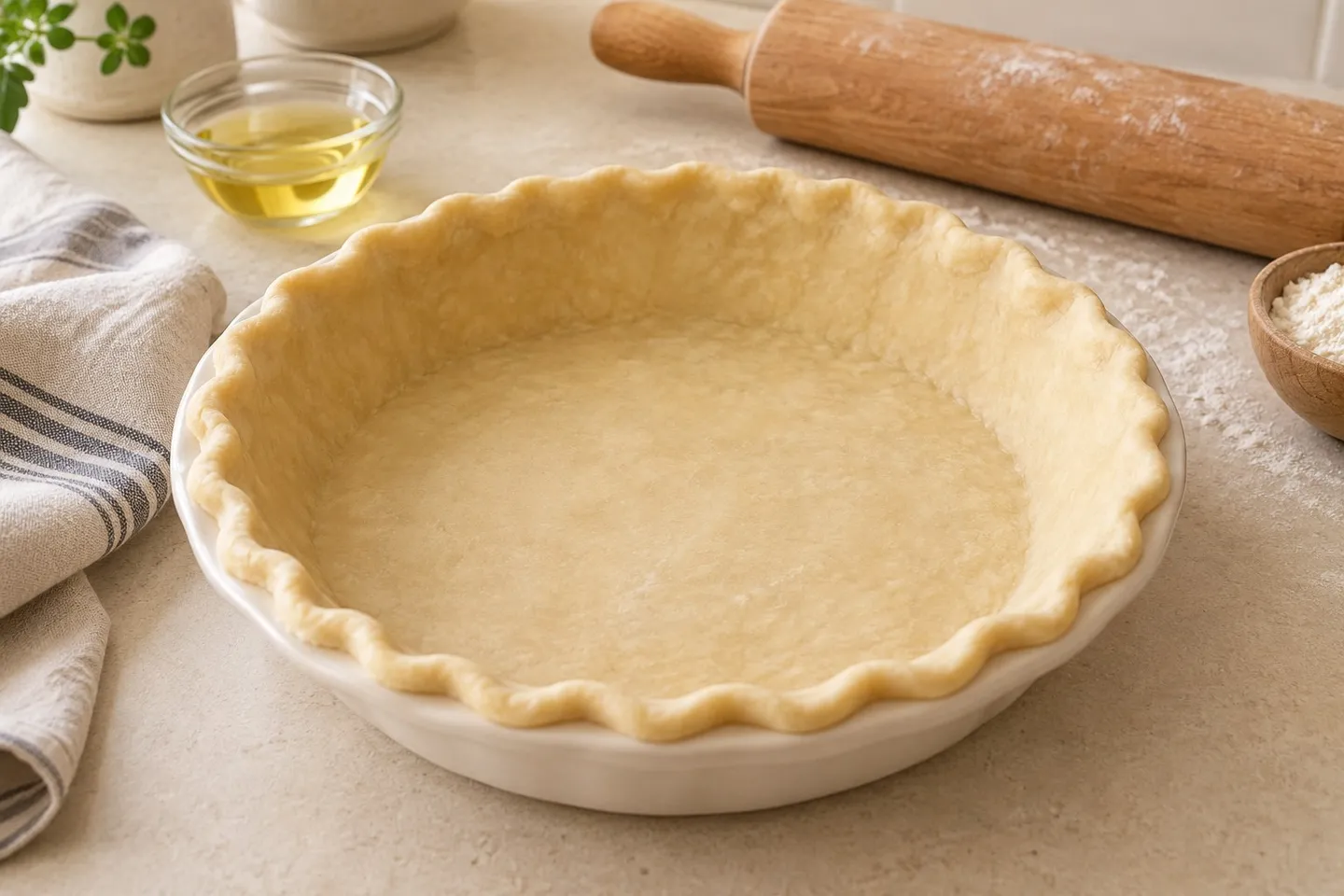
Wartime Salad-Oil Pastry (1941)
An emergency 1941 wartime pie pastry made with liquid salad oil and warm water instead of chilled solid butter or lard.
- Original yieldYield
- 1 single pie crust (9-inch)1 single pie crust (9-inch)
- PrepPrep time
- TotalTotal time
Published Updated
Original recipe: 1 single pie crust (9-inch)
The story behind the recipe
There is no butter to dice for this pastry. The fat pours from a bottle, and tepid water brings it together with self-raising flour. Once mixed, the dough is rolled immediately. It is a different start to a pie from rubbing cold solid fat into flour.
Salad oil isn't salad dressing
Ambrose Heath calls his 1941 recipe Pastry with Salad Oil. The name describes liquid oil, not a prepared dressing. His formula has flour, oil, salt and water; there is no vinegar or bottled dressing hidden in the short list.
Read more about this recipe
Another pastry on the Kitchen Front
Heath's Kitchen Front Recipes and Hints gives this method alongside a pastry using dripping or suet. The liquid-oil version offers another way to make dough in a wartime collection, without requiring every cook to have the same fat available.
Self-raising flour is part of his recipe and stays in ours. It isn't ordinary all-purpose flour with the leavening left for the reader to guess. The different fat and flour forms are reasons to follow this pastry's own method, rather than expect it to behave exactly like a favorite butter crust.
Our single nine-inch crust uses less flour while keeping Heath's three spoonfuls of oil as a modern volume. He mixes oil with water before adding it to the flour and aims for a stiff dough; we add them separately and aim for a soft, cohesive dough. Both methods roll the pastry immediately.
Water helps the dough come together
Heath gives a water guide and allows more to be added gradually as needed. That leaves room for the cook to observe the dough. A prepared measuring cup is useful, but its contents aren't a compulsory target if the flour has already come together.
The method below adds water gradually, using its own softer dough cue. It needs only a brief knead before rolling, without a refrigerator rest. That makes the pastry preparation compact, though the finished pie may take much longer.
Cooking on the Kitchen Front sets this component beside completed dishes such as potato-apple cakes and a vegetable pie. Here, choosing the filling is still ahead. Its preparation, assembly and baking directions will determine the rest of the project.
The ten-minute estimate ends with an unbaked crust in the pie plate. The filling and its baking instructions determine when the pie is ready to slice.
Make it your wayOriginal: 8 servings · Makes 1 single pie crust (9-inch)
Original recipe: 1 single pie crust (9-inch)
Ingredients
For 1 single pie crust (9-inch). Quantities are shown as written.
Source measurement convention: Metric. Explicit unit definitions take precedence; unconfirmed measures must be checked before conversion.
Original quantities for 1 single pie crust (9-inch).
- Self-raising flour (plus a little extra for dusting)250 g
- Vegetable salad oil45 mlAuthor measures: about 3 metric tbsp (1 metric tbsp = 15 ml).
- Fine salt1/2 metric tsp
- Tepid water (or as needed)80 mlAuthor measures: about 1/3 metric cup (250 ml per cup).
Measurement notes
- fine salt: tsp: 1 = 5 ml.
Measurement notes
Original ingredients
- 250 g self-raising flour (plus a little extra for dusting)
- 45 ml vegetable salad oil (approx. 3 tbsp)
- 1/2 tsp fine salttsp: 1 = 5 ml.
- 80 ml tepid water (approx. 1/3 cup, or as needed)
Equipment
 Rolling pin
 9-inch pie plate
Instructions
Whisk flour and salt
In a large mixing bowl, whisk together the self-raising flour and fine salt.
Make a well in the flour
Make a well in the center of the dry ingredients.
Measure oil and water separately
Measure the vegetable salad oil and tepid water separately.
Add oil and water to the flour
Pour all the vegetable salad oil into the well in the flour. Add the tepid water gradually while stirring with a fork, using only as much of the measured 80 ml as needed to bring the dough together.
Stir into a soft dough
Stir quickly until the flour absorbs the liquid and pulls together into a soft, cohesive dough. If dry flour remains after using the measured water, add an extra teaspoon of water.
Knead gently until smooth
Turn the dough out onto a lightly floured surface and knead gently for 30 to 45 seconds until smooth.
Roll and line the pie pan
Roll out the dough immediately into a 30 cm (12-inch) round to line a 9-inch pie pan for a single pie crust.
Follow the chosen pie recipe
Use the unbaked crust in your chosen pie recipe. Follow that recipe's filling preparation, oven setting, baking time and doneness instructions.
Estimated calories 160 kcal
Nutrition portion: 1/8 of recipe · Original yield: 1 single pie crust (9-inch)
Source & assumptions
Ingredient-based estimate using CoFID 2021, USDA SR Legacy (2018). About 160 kcal per nutrition portion (1/8 of the recipe). Standard nutrition portion: one-eighth of the original 9-inch crust. This is an editorial portion basis. Filling and unmeasured dusting flour are excluded. Actual ingredients and preparation affect the estimate.
Recipe notes
When adjusting quantities
Scale ingredients proportionally. Roll out the mixed pastry immediately; filling and baking follow the chosen pie recipe.
Original recipe notes
These notes describe the original recipe. Quantities mentioned here do not change when you adjust servings.
Because this pastry uses liquid oil rather than solid butter, it does not require resting or chilling in the refrigerator before rolling.
The 10-minute estimate covers preparation of unbaked pastry. Filling and baking time depend on the pie recipe. Add the water gradually and use the dough cue rather than forcing in more liquid than needed.
Read the scaling guide. Times, temperatures and equipment need their own consideration. Open the recipe tool to review and correct individual amounts.
Sources and attribution
Ambrose Heath, Kitchen Front Recipes and Hints (1941), p. 47
Ambrose Heath, Kitchen Front Recipes and Hints (1941; May reprint), Pastry with Salad Oil, p. 47.
Recipe details
- Recipe tradition
- Vintage
- Course or meal
- Baking
- Cuisine
- British
- Source decade
- 1940s
- Occasion
- Wartime cooking
- Browse category
- Baking & Desserts