

- Vintage
- Soup
- Cooking techniques
- Measurement
How Meatless Broths Get Their Flavor
Follow three historical soups through browned vegetables, strained broth and softened bread to see where their flavor and texture are built.
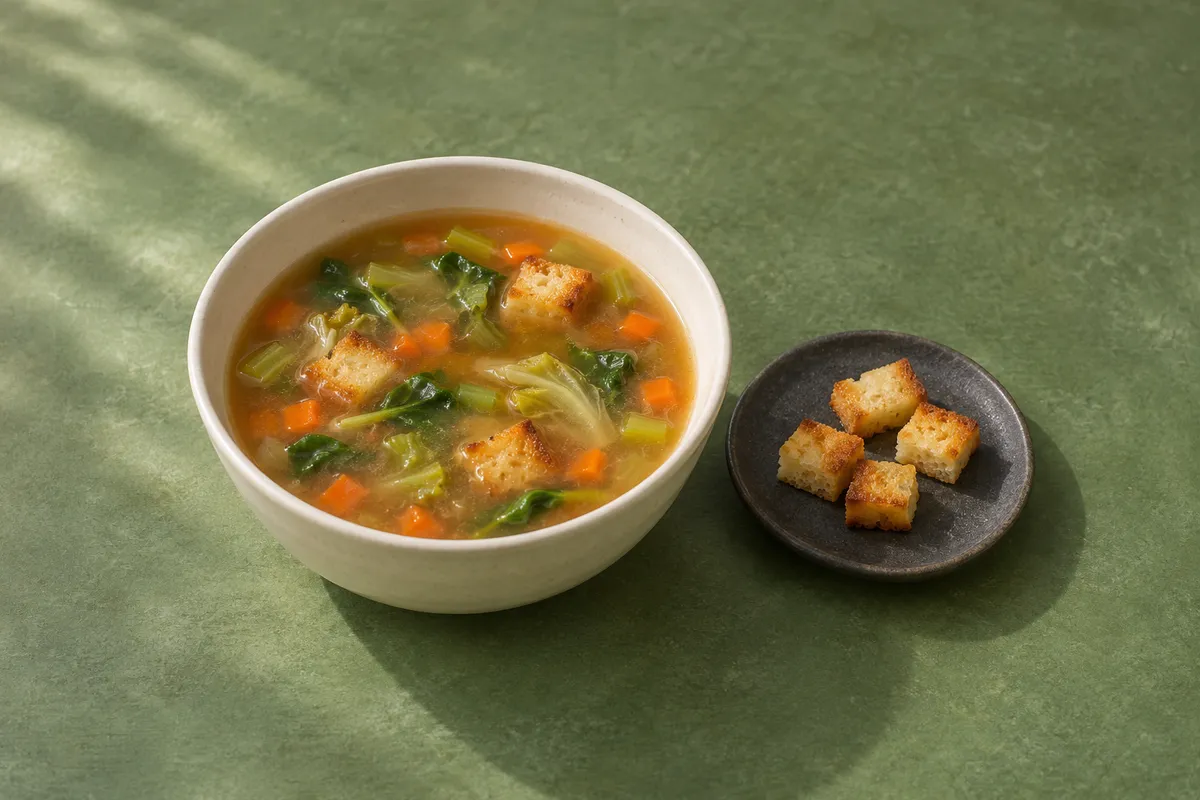
The vegetables you eat needn’t be those that made the broth. In one eighteenth-century French soup, vegetables are browned to flavor water, then strained away. A separately cooked vegetable gives the soup its name and supplies the pieces in the bowl.
That separation makes a useful way into meatless broth. Flavor can be developed in one pan, carried into water and served around another ingredient. Bread may soften into the liquid or arrive fried at the end. The important question is where each part belongs, especially if you’re turning a loosely measured historical recipe into a dinner you can repeat.

Read the diagram as text
What stays in the soup? Separate extraction from serving. Celery broth EXTRACTION: Brown extraction vegetables; add water. STRAIN OUT: Remove the extraction solids. Keep the broth. ADD SEPARATELY: Cook celery in another pan; combine with the strained broth. SERVE: Moisten the serving bread. Onion soup BUILD FLAVOR: Lightly brown the onions; add the selected water. KEEP IN: The onions stay in the soup. SERVE: Bread softens in the soup before ladling. Campbell brown soup INFUSE + STRAIN: Infuse bread and onion; strain out the solids. ADD SEPARATELY: Separately fried vegetables and browned butter/flour. FRIED BREAD: Divide cubes: some in the soup, some on a separate plate. The celery for serving is separate from its extraction vegetables.
Follow the vegetables through two pans
The 1771 La Cuisinière bourgeoise, attributed to Menon, offers several versions of a meatless soup under one heading. Small onions, roots, turnips, cabbage and celery are among its suggested garnishes. Here garnish means a substantial cooked component, rather than a few decorative leaves.
The chosen vegetable is cut, blanched and cooked separately with butter, water and salt. Meanwhile, another saucepan holds butter and a mixture of chopped vegetables, garlic, herbs and spice. The roots in this second pan are cooked and colored before water is added for a half-hour extraction.
Those vegetables are then strained out. The flavored liquid is combined with the separately cooked garnish and used to moisten bread. The book compares the desired broth’s taste and color with one containing meat juice. That is the author’s stated aim for the preparation, not evidence that a modern bowl will be indistinguishable from meat stock.
There is a particularly thoughtful instruction in the middle of the method: leave the garnish vegetable out of the extraction batch. The separately cooked portion will provide enough of its characteristic taste. For a celery version, that means keeping the celery destined for the bowl distinct from the remaining vegetables used to build the broth.
The two batches solve different problems. One can be cooked for the liquid it gives up, without requiring every piece to look attractive at service. The other can retain the identity and texture of the vegetable you intended to eat. Combining everything at the start would erase that choice.
Light brown is already a choice
The neighboring onion soup offers a much shorter route. Sliced onions are cooked in butter until tender and evenly, lightly colored. Water or an available meatless broth is added, followed by bread that softens in the soup.
For Lightly Browned Onion and Bread Soup, the water option keeps that route clear. The onions themselves make the flavor base and remain in the bowl. There is no second vegetable batch to strain and no request for the very dark onion finish familiar from some other soups.
Menon’s milk alternative sharpens the distinction. It uses fewer onions and tells the cook to soften them without coloring. Boiling milk is added, and sliced bread is soaked with the liquid in the serving dish. Browning is therefore an instruction to select for a particular soup, not an automatic improvement to every meatless preparation.
That’s a useful check when reading old methods. If one version says to avoid color, letting the onions brown because another soup did so changes the preparation. Likewise, “water or broth” offers two liquid choices; it doesn’t require a stock cube in a version deliberately made with water.
A later brown soup builds flavor in several stages
Tunis Campbell published a different brown soup in his Hotel Keepers, Head Waiters, and Housekeepers’ Guide of 1848. His recipe starts with water, bread raspings, onion and seasonings. That mixture is boiled under a lid and strained before the rest of the soup is assembled.
The next vegetables take another route. Celery, carrots, endive, lettuce, spinach and herbs are fried in butter. In a clean stewpan, more butter and flour are stirred until brown. The strained liquid and vegetables are then combined and cooked until the vegetables are tender and the soup has the intended thickness.
There are several distinct operations here: a bread-and-onion infusion, vegetable frying and flour browning. Calling it simply vegetable soup would leave a cook with little sense of the work that creates its character. Pouring every ingredient into water together wouldn’t follow Campbell’s sequence.
The finishing bread is separate again. Bread cubes are fried brown, with some put into the soup and the rest served on a plate. The portions enter the liquid at different times. Bread already in the bowl has a chance to soften; bread on the side waits for the eater.
Campbell’s book title supplies a service context, but the printed recipe doesn’t establish that this exact soup was served in a particular hotel. Its more useful evidence for a home cook is visible in the method itself: broth, vegetables, thickening and fried bread are prepared with their eventual service in mind.
Keep the three soups distinct
| Preparation | What flavors the liquid | What remains to eat |
|---|---|---|
| Celery in Browned Vegetable Broth | A separate batch of colored vegetables, herbs and spice, then strained | Separately cooked celery and softened serving bread |
| Lightly Browned Onion and Bread Soup | Lightly colored onions cooked directly in the selected water base | The onions and bread softened in the soup |
| Brown Vegetable and Bread Soup | A strained bread-and-onion infusion, fried vegetables and browned flour | The later vegetables, with fried bread divided between soup and plate |
Their body and flavor aren’t the same question. Browned extraction vegetables can be removed from a flavorful broth; bread can make a bowl fuller while continuing to absorb its liquid. If you’re choosing a thickening method, Why Soup Gets Thick follows that separate decision through beans, crackers and a flour slurry.
Measure what survives the strainer
An old recipe can give a water quantity while leaving nearly everything else to judgment. Campbell starts with three quarts or more and calls for enough raspings to thicken it. That doesn’t provide a complete modern formula simply because the water can be converted to liters.
Suppose an adaptation begins with half of the minimum water allowance. Under a declared US-quart convention, one and a half quarts is about 1.42 liters. That is a calculation for the starting water only. It doesn’t establish the weight of an unquantified piece of butter, how much bread counts as sufficient, or the finished yield after simmering and straining. Those require explicit recipe decisions.
Measure the recovered liquid if you want to understand a batch. Some water may have evaporated, and some liquid remains with the solids removed by the sieve. Neither the initial water quantity nor an expected number of bowls tells you exactly what is waiting in the clean pan.
Prepared vegetable weights deserve the same care. Weigh peeled onions and trimmed vegetables in the forms the modern recipe specifies. A dozen historical onions of unspecified size can’t be converted into a precise peeled weight by counting alone.
Plan the bread at serving time
The three soups leave different work for the final minutes. Celery broth needs its cooked garnish ready when the strained liquid arrives. The simple onion soup keeps its bread in the soup. Campbell’s version asks for fried cubes and a separate plate as well as the soup itself.
Choose the arrangement before preparing all the bread. Dry raspings used for extraction aren’t the same ingredient as the cubes reserved for frying, and one convenient bag of crumbs can’t silently stand for both. The guide to fresh crumbs, dried crumbs and panko helps identify those forms.
A larger batch still needs pan space for its browning stages and a suitable strainer for its liquid. Increasing the ingredient amounts doesn’t tell you to multiply the cooking times. Follow tenderness, color and the recipe’s sequence, with the serving bread ready for the moment it is meant to meet the broth.
Sources
La Cuisinière bourgeoise, attributed to Menon, Paris: P. Guillaume Cavelier, 1771, pp. 17–18, the complete vegetable-broth and onion-soup entries. Tunis Campbell, Hotel Keepers, Head Waiters, and Housekeepers’ Guide, Boston: Coolidge and Wiley, 1848, pp. 149–150, To make a Brown Soup. The modern companion recipes select and quantify particular versions; these historical prescriptions aren’t records of observed meals.