
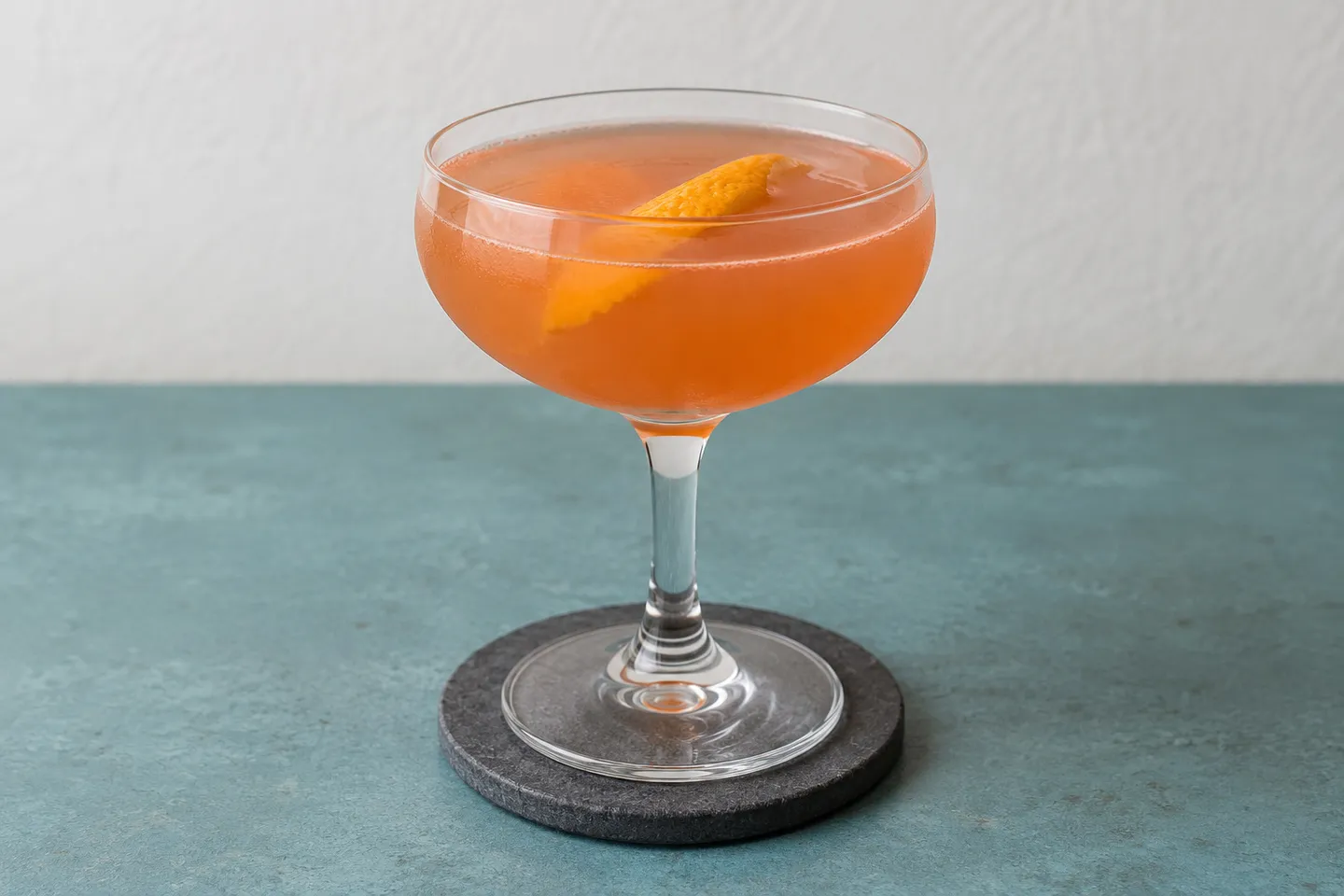
The Monkey Gland (1923)
A cheeky 1920s Paris creation combining London dry gin, fresh orange juice, and real pomegranate grenadine with an aromatic absinthe rinse.
- Original yieldYield
- 1 cocktail1 cocktail
- PrepPrep time
- TotalTotal time
Published Updated
Original recipe: 1 cocktail
The story behind the recipe
Fresh orange juice gives the Monkey Gland a generous fruit base, while a thin absinthe coating puts anise aroma around it. Gin and pomegranate grenadine fill out the mixture.
A rinse around the fruit
The modern recipe uses absinthe to coat the chilled glass, then discards the excess. It's a small aromatic preparation, separate from the liquid shaken in the mixing vessel.
That differs from adding a dash of absinthe throughout the cocktail. A rinse leaves some flavor around the bowl, where the fruit mixture meets it. The amount used to coat the glass isn't all retained in the drink.
Pastis is an offered alternative for the rinse. It changes the flavor and sweetness, so choose it as a variation rather than assuming every anise-flavored bottle is identical.
Read more about this recipe
McElhone's extraordinary name
Harry McElhone credits himself with the Monkey's Gland in his 1923 Harry of Ciro's ABC of Mixing Cocktails. He relates its name to Voronoff's rejuvenation experiments. That is McElhone's account in the book, a period explanation for a name that can still make someone look twice.
The formula itself is concise: equal proportions of Gordon gin and orange juice, a teaspoonful of grenadine and a dash of absinthe. The central gin-and-orange combination also appears in his 1927 Barflies and Cocktails.
The drink is more approachable than its title suggests. There is fruit you know, gin you can choose and a small anise element to notice. The bar-book article places the name beside several other revealing details from McElhone's pages.
Equal measures of gin and orange
Orange juice supplies flavor and body without reducing gin to a token splash. Both have the same measure in this serving, so the spirit remains a substantial part of the mixture.
Strained fresh juice keeps heavy pulp out of the short drink. Some natural body remains; there is no reason to chase perfect transparency in an orange cocktail.
Pomegranate grenadine sweetens and colors it. Buy the real fruit syrup listed, then keep that bottle when comparing servings. Changing the syrup can alter sweetness and fruit flavor even when the measure doesn't change.
The gin choice is London dry. Its botanicals meet a sweeter, gentler citrus than the lemon in a Sidecar, which uses brandy and orange liqueur instead.
Orange above the orange
The twist adds fresh peel aroma at the surface, separate from the juice mixed through the drink. It's a modern garnish, with the absinthe rinse taking the place of the source's shaken dash.
For more of the bar-book background, read about cocktails in 1920s London and Paris on our sister site, Forgotten Drink.
Make it your wayOriginal: 1 serving · Makes 1 cocktail
Original recipe: 1 cocktail
Ingredients
For 1 cocktail. Quantities are shown as written.
Source measurement convention: Metric. Explicit unit definitions take precedence; unconfirmed measures must be checked before conversion.
Original quantities for 1 cocktail.
- London dry gin45 ml
- Fresh orange juice (strained)45 ml
- Real pomegranate grenadine7.5 ml
- Absinthe (or pastis, for glass rinse)2.5 ml
- Orange twist (for garnish)1
Measurement notes
Measurement notes
Original ingredients
- 45 ml London dry gin
- 45 ml fresh orange juice (strained)
- 7.5 ml real pomegranate grenadine
- 2.5 ml absinthe (or pastis, for glass rinse)
- 1 orange twist (for garnish)
Equipment
 Cocktail shaker
 Hawthorne strainer
 Chilled coupe glass
 Bar spoon
Instructions
Rinse the coupe with absinthe
Pour the absinthe into a chilled coupe glass, swirl it around to coat the entire inside surface of the bowl, and discard the excess.
Combine gin, orange and grenadine
In a cocktail shaker, combine the London dry gin, fresh orange juice, and real pomegranate grenadine.
Fill the shaker with ice
Fill the shaker with cracked ice.
Shake to chill
Shake hard for 12 to 15 seconds until thoroughly chilled.
Strain into the prepared coupe
Strain the cocktail into the absinthe-rinsed coupe glass.
Express and add orange twist
Twist the orange twist over the surface to release its aromatic oils and place gently into the glass to serve.
Estimated calories 150 kcal
Nutrition portion: whole recipe · Original yield: 1 cocktail
Source & assumptions
Ingredient-based estimate using USDA SR Legacy (2018), representative labels for 58 and CO London Dry Gin (43% ABV), Liber & Co Real Grenadine, Pernod Absinthe (68% ABV). About 150 kcal per nutrition portion (whole recipe). Uses representative London dry gin at 43% ABV and real pomegranate grenadine. Includes the full 2.5 ml allowance of a representative 68% ABV absinthe rinse; discarding the excess may lower the estimate by up to about 9 kcal. Actual ingredients and preparation affect the estimate.
Recipe notes
When adjusting quantities
Scale ingredients proportionally. The absinthe rinse should coat the glass without overpowering the fruit.
Original recipe notes
These notes describe the original recipe. Quantities mentioned here do not change when you adjust servings.
McElhone, Harry of Ciro's ABC of Mixing Cocktails (1923), p. 48; Barflies and Cocktails (1927), p. 46. Equal gin and orange portions are retained. Measured sweetness, London dry gin, the absinthe rinse and orange twist are modern choices.
The source shakes its absinthe into the mixture. Here it coats the glass and excess is discarded, so the rinse measure isn't all retained.
Strain orange juice to remove heavy pulp. Pomegranate grenadine varies in sweetness; use the same product when comparing batches.
Read the scaling guide. Times, temperatures and equipment need their own consideration. Open the recipe tool to review and correct individual amounts.
Sources and attribution
Harry McElhone, Harry of Ciro's ABC of Mixing Cocktails (1923), p. 48; Barflies and Cocktails (1927), p. 46
Recipe details
- Recipe tradition
- Vintage
- Course or meal
- Drink
- Cuisine
- French
- Source decade
- 1920s
- Browse category
- Drinks & Cocktails