
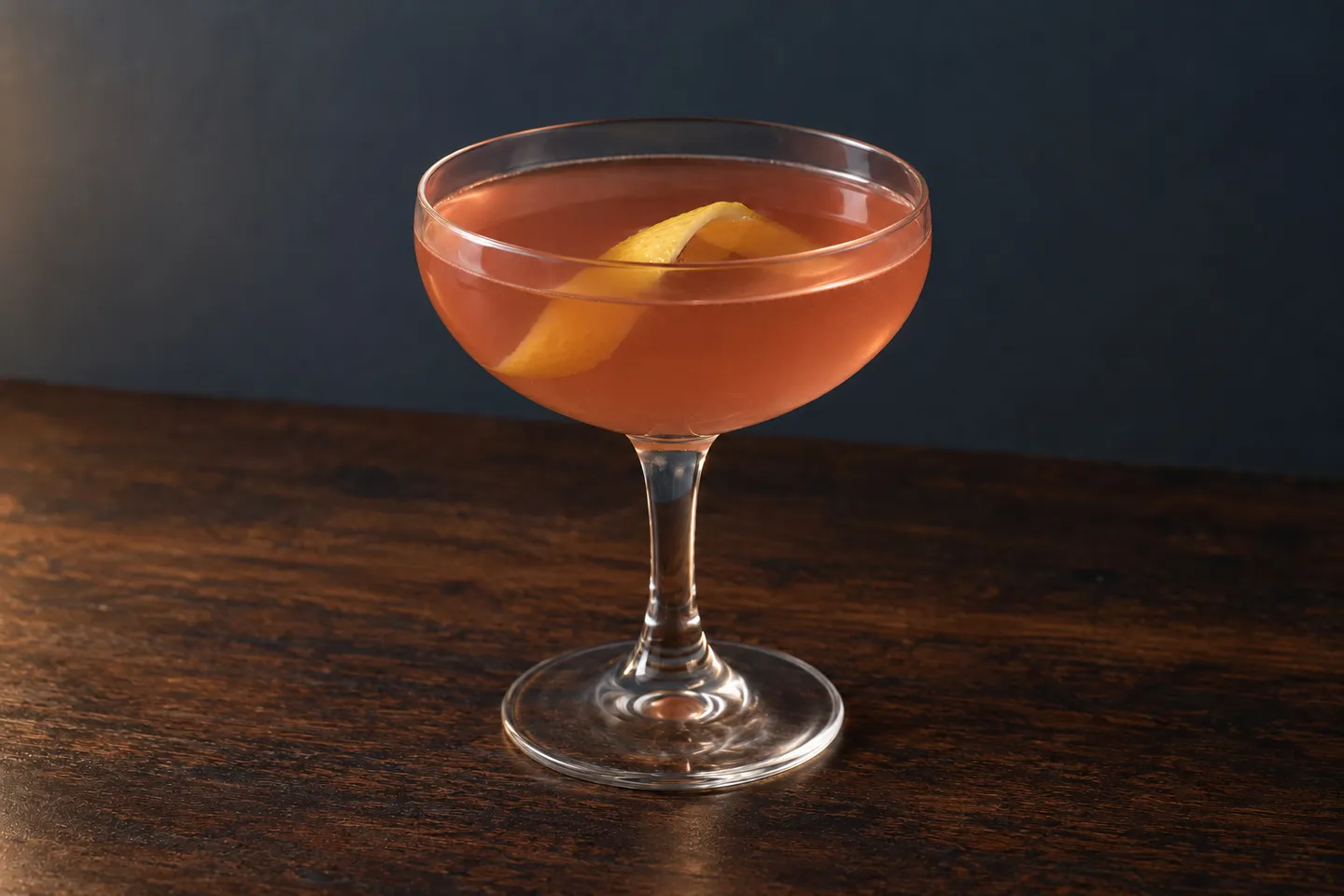
The Scofflaw (1924)
A defiant 1924 Paris cocktail blending spicy American rye whiskey, dry French vermouth, lemon juice, grenadine, and orange bitters.
- Original yieldYield
- 1 cocktail1 cocktail
- PrepPrep time
- TotalTotal time
Three minutes assumes a coupe chilled in advance and prepared juice.
Published Updated
Original recipe: 1 cocktail
The story behind the recipe
Dry vermouth is a substantial part of the Scofflaw, alongside rye, lemon and pomegranate grenadine, with orange bitters to season the mixture. It's tart, sweet and herbal at once, finished with a lemon twist.
A name reported from Paris
Harry McElhone's 1927 Barflies and Cocktails prints the Scoff-law beside an account attributed to the Chicago Tribune of January 27, 1924. The reproduced passage credits Jock at Harry's New York Bar with naming a cocktail in response to the new term “scoff-law.”
The newspaper account, as the book reproduces it, reports enthusiasm among American visitors escaping Prohibition. It gives the name a lively period setting.
The formula on the page uses rye, French vermouth, lemon, grenadine and a dash of orange bitters. The 1924 date refers to the dated account reproduced in the 1927 book. The Jazz Age bar-book article puts this newspaper voice alongside other short recipe-bearing passages.
Read more about this recipe
Wine makes the difference
The vermouth is dry French vermouth. It adds wine and herbal flavor beside lemon, giving the rye a crisper companion than the sweet vermouth used in a Boulevardier.
Grenadine supplies the sweetness and pomegranate flavor. The citrus and syrup measures are equal in this recipe, but they taste quite different: lemon sharpens, while grenadine rounds the mixture.
Use the pomegranate syrup listed and a rye whose spice you enjoy. A drink with several ingredients still leaves room to recognize the whiskey, especially with the larger rye share used here.
The rye steps forward
McElhone's proportions give rye and vermouth equal shares, with half as much each of lemon and grenadine. The modern recipe raises the rye while leaving lemon and grenadine equal.
It keeps the wine component prominent but gives whiskey the larger voice.
Orange bitters add a different citrus scent from the lemon juice. The dash is small, and remains a dash in both the printed formula and the written ingredient list.
A cold glass with a lemon finish
Shaking chills, dilutes and joins the syrup and citrus to whiskey and vermouth. The coupe receives a strained drink without serving ice, leaving the short mixture plain beneath the twist.
Lemon peel supplies aroma across the top without adding another measure of juice. The method expresses its oils, rubs the rim and leaves the peel in the glass.
Keep the vermouth refrigerated once open. Fresh wine flavor is especially relevant when a recipe gives it this much room.
The Scofflaw's name is an enjoyable detail to offer with the drink. Its dry vermouth and pomegranate are the more useful description when someone is choosing between whiskey cocktails.
For more of the bar-book background, read about cocktails in 1920s London and Paris on our sister site, Forgotten Drink.
Make it your wayOriginal: 1 serving · Makes 1 cocktail
Original recipe: 1 cocktail
Ingredients
For 1 cocktail. Quantities are shown as written.
Source measurement convention: Metric. Explicit unit definitions take precedence; unconfirmed measures must be checked before conversion.
Original quantities for 1 cocktail.
- Straight rye whiskey45 ml
- Dry French vermouth30 ml
- Fresh lemon juice (strained)15 ml
- Real pomegranate grenadine15 ml
- Orange bitters1 dash
- Wide lemon peel twist (for garnish)1
Measurement notes
Measurement notes
Original ingredients
- 45 ml straight rye whiskey
- 30 ml dry French vermouth
- 15 ml fresh lemon juice (strained)
- 15 ml real pomegranate grenadine
- 1 dash orange bitters
- 1 wide lemon peel twist (for garnish)
Equipment
 Cocktail shaker
 Hawthorne strainer
 Chilled coupe glass
Instructions
Use a chilled coupe
Use a coupe glass chilled in advance.
Combine the drink ingredients
In a cocktail shaker, combine the straight rye whiskey, dry French vermouth, fresh lemon juice, real pomegranate grenadine, and orange bitters.
Fill the shaker with ice
Fill the shaker with cracked ice.
Shake to chill and aerate
Shake vigorously for 12 to 15 seconds until thoroughly chilled and lightly aerated.
Strain into the chilled coupe
Strain through a Hawthorne strainer into the chilled coupe glass.
Express and add lemon peel
Express the oils from the wide lemon peel twist across the top of the drink, rub the rim, and drop the peel into the glass to serve.
Estimated calories 170 kcal
Nutrition portion: whole recipe · Original yield: 1 cocktail
Source & assumptions
Ingredient-based estimate using CoFID 2021, identified manufacturer information. Approximately 170 kcal per nutrition portion. Uses 40% ABV rye, representative dry vermouth, Liber pomegranate grenadine and The Bitter Truth orange bitters at a representative 1 ml per dash. Lemon peel is excluded. Ingredients, brands and preparation affect values.
Recipe notes
When adjusting quantities
Scale ingredients proportionally. Shake vigorously with ice to integrate the citrus and dry vermouth.
Original recipe notes
These notes describe the original recipe. Quantities mentioned here do not change when you adjust servings.
McElhone, Barflies and Cocktails (1927), p. 63, reproducing the Chicago Tribune account dated January 27, 1924. We give rye a larger proportion than the source's equal rye/vermouth measures, retain equal lemon and grenadine, and supply the shaking method and lemon garnish.
Choose a rye whose spice you enjoy. Refrigerate dry vermouth after opening and use it while its flavor is fresh.
Read the scaling guide. Times, temperatures and equipment need their own consideration. Open the recipe tool to review and correct individual amounts.
Sources and attribution
Harry McElhone, Barflies and Cocktails (1927), p. 63, quoting the Chicago Tribune of January 27, 1924
Recipe details
- Recipe tradition
- Vintage
- Course or meal
- Drink
- Cuisine
- French
- Source decade
- 1920s
- Browse category
- Drinks & Cocktails